
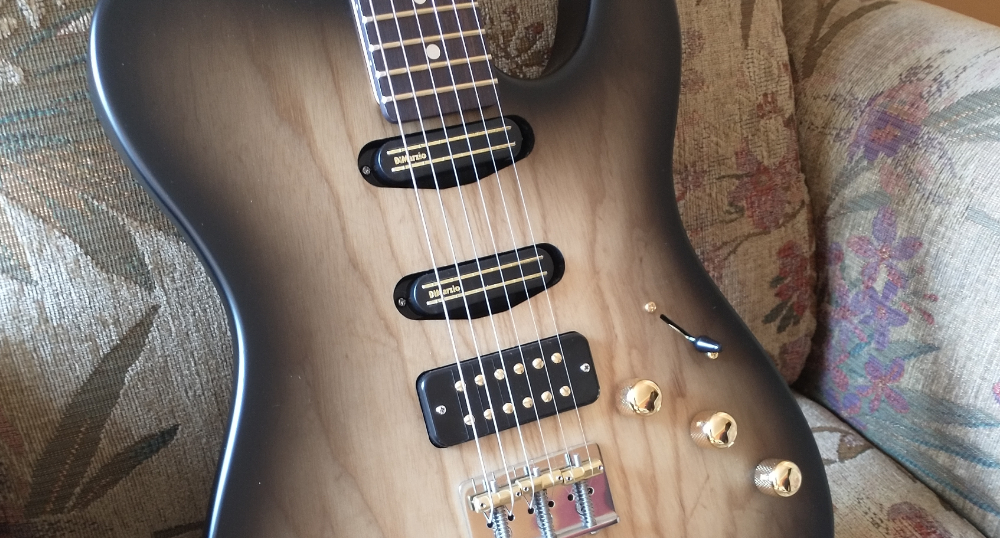
For most of my life I was a guitar purist. I’ve owned many of the most sought after vintage guitars and tube amps and basically I just plugged into the amp, and used a little reverb… no pedals. As my long career as a graphic artist was winding down I decided to look into some of the newer guitars and amps available and look at adding some pedals, for fun. After spending some time looking at what was available at my local music stores I realized most new models of the guitars I’d owned were no longer vintage spec anymore. The necks were thin and flat and the overall weights were getting heavier… i.e. if you wanted a larger neck, and a lightweight guitar you were looking at custom shop strats and teles. Which were too expensive and more than I wanted to spend.
Research
I started to research online stores for custom shop strats and teles to see what was available and found Wildwood guitars, an online dealer in Louisville Colorado. Pretty much the Holy Grail for custom shop strats and tele, and they had a lot of guitars listed that were spec’d with larger vintage style necks and an overall guitar weight under 7 lb. The prices were out of my range at the time but it got me thinking why did Wildwood have all of these guitars spec’c like I wanted …that weren’t available at the music stores in my area? Answer, they ordered them that way and people came to Wildwood for the good stuff. That got me thinking: could I find lightweight bodies and necks spec’d to my preferences and build something myself? Hmmm…
Warmoth Guitars
I was aware of Warmoth guitars from years of tinkering with my own guitars and looking at companies that sold parts online. But I hadn’t looked at Warmoth products in a long time. So I started reviewing their website, looking at bodies and necks, and checking the specs. That’s when I noticed they had the weights listed for the guitar bodies. Seeing the guitars that Wildwood were offering got me wondering, how much would a strat or tele body weigh to build a complete vintage spec’d guitar under 7 lbs. I decided to find out. So my big guitar building experiment began…
Building a guitar to my specs
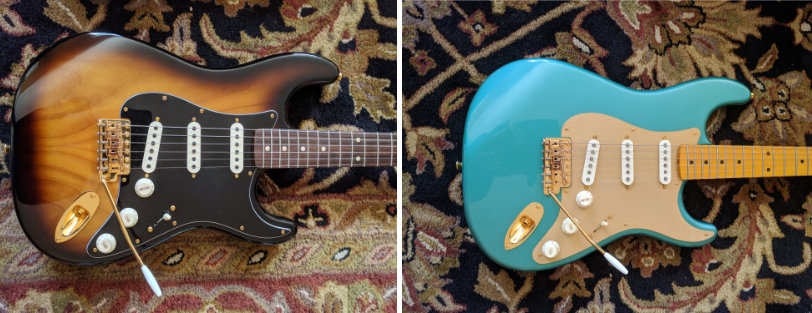
I decided to purchase a couple bodies and necks from Warmoth, and start building a complete guitar… As I purchased all of the parts necessary, I began weighing them. I wanted to create a profile of what each part weighed and what the body weight would have to be to create say, a strat under 7lbs. I created a simple database where I could enter In the price and weight for each part of a basic bolt-on guitar. I could then spec out a complete guitar with my database, i.e. total weight, and cost. And focus on features: color, pickups, electronics etc. Voila!
Assembly
So what do you need to build a bolt-on neck guitar? The main parts: body and neck, electronics: pickups and pots/wiring. Then you have the the bridge; fixed or vibrato; tuners, screws and miscellaneous other parts like strap holders and pickguard. When you have all the parts assembled you’ll need a soldering iron for wiring the pickups to volume and tone pots and input jack and switch. You’ll need some type of drill to drill holes for tuner install and pickguard screws. I use a Dremel tool myself but you can use a regular drill but they are a little large and cumbersome. Warmoth bodies come with routes for neck, bridge and tremelo cavity but you’ll have to drill holes for the input jack, pickguard and strap holders.
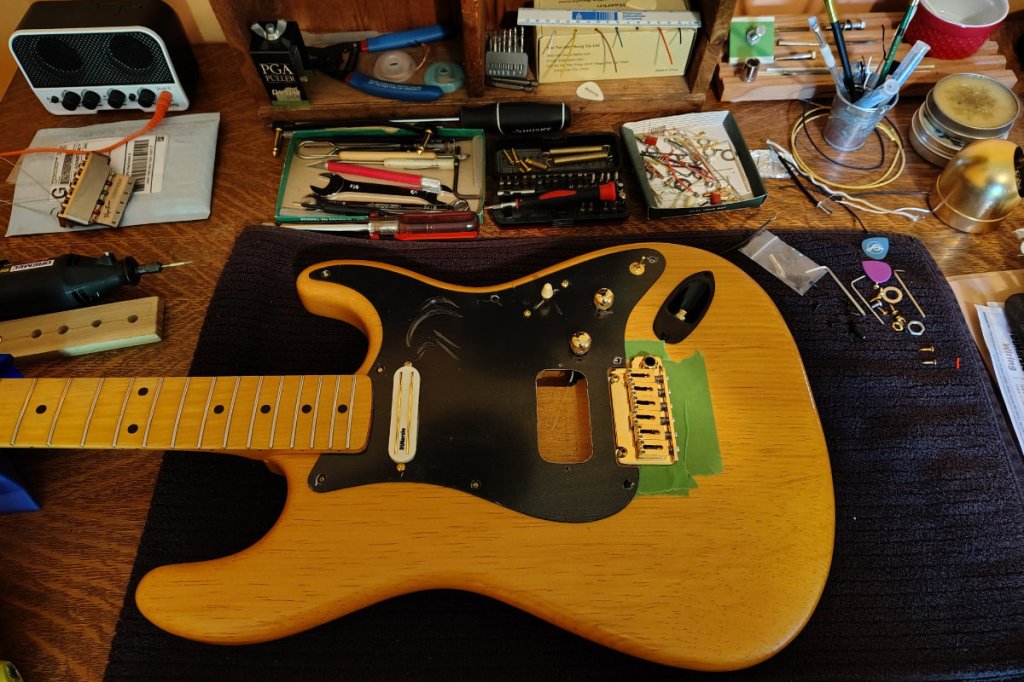
The basic Skillset needed: Soldering skills: something anyone can learn but it does take practice to do it cleanly without making a mess. Measuring: with some type of small ruler or guitar specific gauges. And probably most important is “Take Your Time and Be Carefu”l! Needless to say, messing up a $350-500.. brand new, painted guitar body, because of mistakes, drops, spills or other OOPS moments, is not what you want to do. Always a good idea to cover the guitar with a cloth while working on an area and tape it off while drilling. I even use cloth gloves while working on a guitar final assembly. You are going to get dents, nicks and scratches over the life of any guitar but you don’t want to start out with some glaring screw ups that will be staring at you every time you pick up the guitar! Trust Me.
Conclusion
Should everybody build their own guitar? Probably not. But if you’re handy with tools, have an eye for detail and are willing to take the time to learn some new skills… you can build a bolt-on neck guitar that is equal to or better than most of the factory built guitars at your local music store. And you can build it from higher quality parts customized to your specs. Plus, I dare say, there’s an added sense of pride, knowing you built the guitar yourself. In the end, playing the guitars that I built myself, means more to me than the logo on the headstock.


Leave a Reply